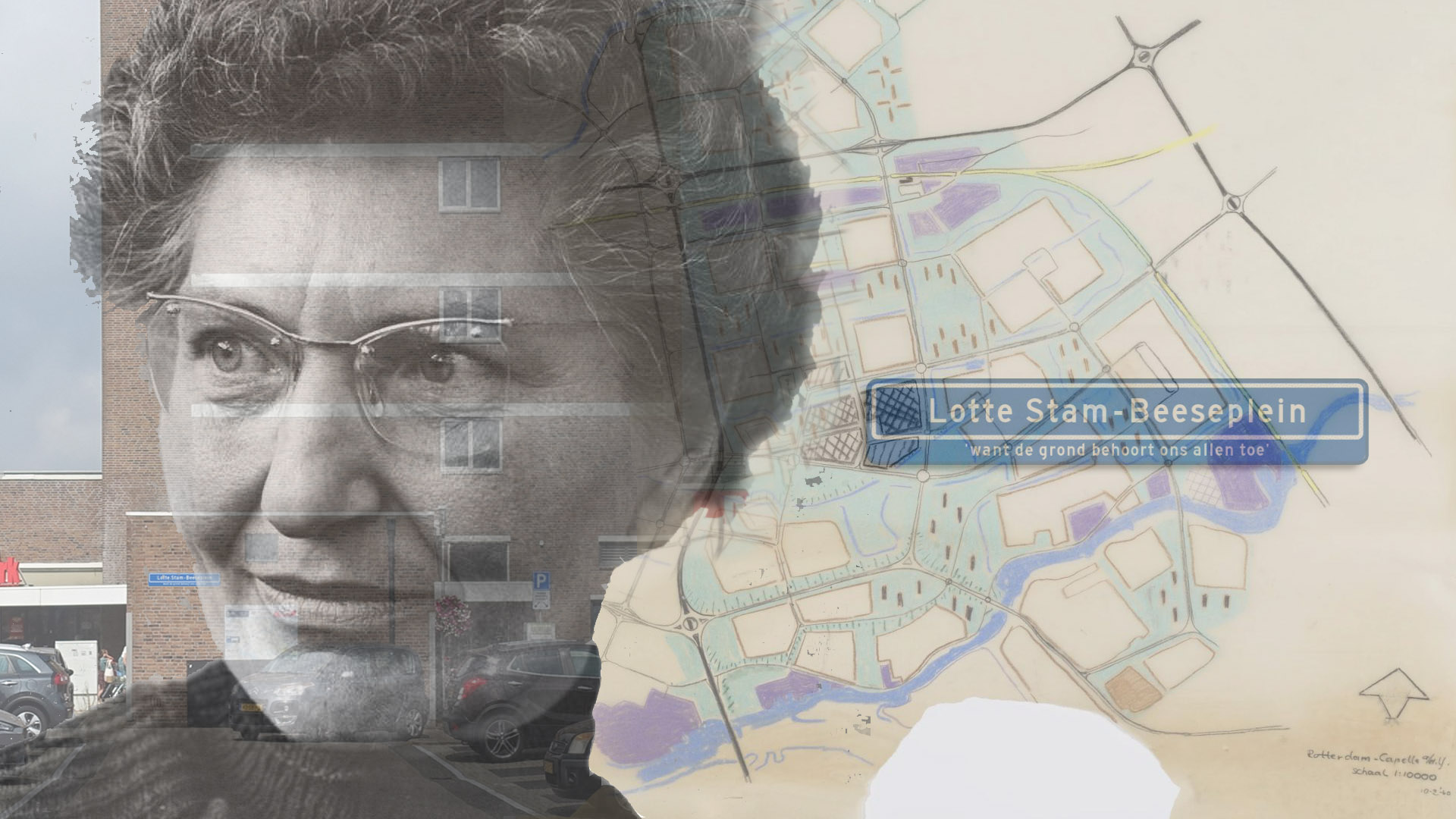
KRIMPEN AAN DEN IJSSEL – At the end of last year, this municipality, together with me, presented the 'Lotte Stam-Beeseplein', a village square that (still) exists only in the realm of our imagination. It's named after the extraordinary Krimpen resident and urban planner Lotte Stam-Beese (1903–1988). She played a key role in Rotterdam and beyond during the post-war reconstruction period. The sign, which overlooks a large parking lot, bears one of her memorable sayings: "Because the ground belongs to all of us."
As an artist, I'm convinced that sometimes you have to present the ferry from the past (owned by the Van der Ruit family) in today's situation, in order to realize that the village of the past no longer exists. If you fail to imagine the future, Maakdestad advises preserving the qualities of the vanished village in its new environmental future vision. That seems harmless (coming from these city-makers) – but you don't wear clothes that no longer fit.
It was 1962 when comedian Wim Sonneveld (1917–1974) wrote the song "A sultry night in Krimpen aan den IJssel". At the same time, Lotte Stam-Beese was working on the expansion plans for Rotterdam-Oost/Capelle aan den IJssel. These plans included a sub-city for 175,000 residents and an expansion to Krimpen aan den IJssel. For the village center, this marked the end of the sultry night in T'Enge and the beginning of the Crimpenhof.
So you could say that Krimpen aan den IJssel is also the result of reconstruction optimism. Lotte had lived in a small house at the foot of the IJsseldijk since 1964. Her sketches from that time show a metro line and a second river crossing for the village. She was far ahead of her time. In the 1980s, the municipality sold the village street. The indoor shopping centre won awards. Today, little remains of this optimism. Some Krimpen residents see the rivers as their moat. Designed to keep the city out. Now that the drawbridge (Algerabrug) is on the verge of collapse, they have to cycle to Rotterdam this summer. The rest are screaming out loud about the village's lack of accessibility. If only we had listened to Lotte...
Plein 1953 was never named after Pendrecht's mother. It does, however, refer to the flood that claimed four lives in Krimpen. A disaster that Dr. Ir. Johan van Veen (1893-1959), founder of the first Delta Plan, tried his best to prevent. This took a toll on his health. On December 9, 1959, he died of his fourth heart attack on the train to The Hague. He witnessed the construction of the bridge over the Hollandsche IJssel, but it was named after the politician Jacob Algera (1902-1966). Sixty years after Johan van Veen's death, Capelle aan den IJssel dedicated a memorial to him. The search for the "face" of Krimpen continued.
It were residents of Krimpen, in a workshop of NV Lubbers Constructiewerkplaatsen (now Hollandia), who constructed the famous artwork by Naum Gabo (1890-1977) for the Coolsingel in 1957. The National Moluccan Monument Foundation is working from this village towards the unveiling of the monument on the Lloydkade in Rotterdam on June 21, 2026. Krimpen resident and nature pioneer Kees Beaart initiated a memorial in Middelburg for painter and entomologist Johannes Goedaert (1617-1668). Meanwhile, in Krimpen aan den IJssel, the dike house adapted by the architect Lotte Stam-Beese was demolished.
When Krimpen residents become well-known, they soon become Rotterdammers. Think of football coach and former player Giovanni van Bronckhorst, who received a statue at the Rotterdam Museum in 2017. A playing girl, created by artist Kees Verkade (1941-2020), stands on Raadhuisplein. But every new playground in this village is met with resistance. It’s as if the residents have to learn how to play again.
In 1995, Mayor Bram Peper (1940-2022) wanted to merge villages like Krimpen aan den IJssel into the city-province of Rotterdam. But Rotterdammers, are not Krimpen residents, and put a stop to it. The lack of a future-oriented narrative for the village allowed nostalgia to take over. It's therefore no wonder, that we've been searching for the "Heart of Krimpen" for years now. When the IJssel-stone body looks in the mirror, the vanished village quickly looms.
In December 2025, a statue of Paulina Bisdom van Vliet (1840-1923) was unveiled in the Haastrecht Overtuin. As a wealthy Haastrecht resident, she built a new social status by providing financial support to virtually all social initiatives. Now that a memorial for Lote Stam-Beese, a native of Krimpen, is being considered in Rotterdam Ommoord, perhaps it's time in the municipality of Krimpen aan den IJssel to put Aat van Herk, a native of Krimpen and the largest real estate owner in the village street, on a pedestal. The missing vibrant village center is, above all, a human creation, isn't it?
Edwin Stolk – visual artist
THE PERFORMANCE - is an artistic investigation in collaboration with the Municipality of Krimpen aan den IJssel, a quest for the "face" of the village center. What possibilities might arise if we view the village as a collaborative art project, the street as a monument for knowledge exchange, and the municipal Instagram account as a cultural (exhibition) space?
[Various versions of this column were previously submitted to the AD newspaper and Het Kontakt.]
[Photo editing: Edwin Stolk]